
INDUSTRIAL MACHINERY
Industry 4.0 is changing automation. Collaborative robots, AI and predictive maintenance bring machines closer to operators, maintenance staff and even the public, and the reliability of safety functions becomes paramount. Connected machines also expose company data and production itself to cyberattacks through IoT features and production management systems.
From 20 January 2027, the Machinery Regulation (EU) 2023/1230 replaces the Machinery Directive 2006/42/EC. It applies directly in all EU Member States and brings new requirements for safety-related control systems and software, protection against corruption and cyberattacks, autonomous mobile machinery, human–machine interaction and digital instructions. Machinery whose safety functions rely on self-evolving machine learning will always need a notified body. CertX helps you prepare your products and technical documentation for the transition.
Developing, importing or rebranding a robot? See our page Robotics & Humanoids, including when you become the manufacturer.
We certify safety components and machine control systems, and assess your industrial networks and cybersecurity processes to find threats before attackers do.
Notified Body NB 2948: EC Type-Examination
CertX is Notified Body NB 2948, listed in the EU NANDO register, for the EC type-examination (Annex IX) of two categories of the Machinery Directive 2006/42/EC, Annex IV:
- 19. Protective devices designed to detect the presence of persons
- 21. Logic units to ensure safety functions
Typical products are safety laser scanners, light curtains and other person-detection systems, safety relays, safety PLCs and the safety controllers of machines, robot cells and robots. Under the Machinery Regulation (EU) 2023/1230, both categories are listed in Annex I, Part B: if your product does not fully apply the harmonised standards, a notified body must be involved.
We review your risk assessment according to EN ISO 12100 and evaluate safety-related control systems against harmonised standards such as EN ISO 13849-1, EN IEC 62061, EN IEC 61496 for electro-sensitive protective equipment and EN IEC 61800-5-2 for the safety functions of drives.

The EC type-examination certificate lets you complete the EU declaration of conformity and affix the CE marking. Learn more about our certification process.
Beyond functional safety and cybersecurity, CertX helps you identify all regulations and standards that apply to your machine and checks your technical documentation before market launch.
Product Inspection & Certification for Functional Safety
Our services verify the compliance of your product with functional safety standards, for example a safety component, a control system or safety-related equipment integrated into a machine. You can demonstrate compliance with IEC 61508, EN IEC 62061, EN ISO 13849 or other standards to your clients without disclosing your IP. Our detailed findings help you improve your product and reduce product liability risks.
CertX provides an independent assessment of the parts of the standard your project needs. See also our Functional Safety & RAMS services.

Functional Safety Management:
- Management system
- Policy
- Functional safety planning
- Configuration Management
- Organization and competencies
- Life-cycle planning
- Documentation
- Conformance plan
- Supplier management
Hardware:
- Failure rates & Diagnostics
- Safe-failure fraction & Hardware fault tolerance
- Data communication
- Maintenance
- Measures for systematic fault avoidance
System:
- Hazard and risk analysis (risk graph, layer of protections,…)
- Review of overall system specification & safety requirements
- Product identification & specification
- Mission profile evaluation
Software:
- Safety & integrity function requirements
- Requirement traceability
- Safety functions and diagnostics
- Testability and tests
- Data communication
- Proven in use arguments
- Supporting tools
- Module & integration testing
- Impact analysis
- Validation
Cybersecurity for Industrial Systems and OT Security Management
Security is becoming a priority in industrial IT and operational technology (OT) as connectivity grows and attacks on production systems increase. Many companies are still not aware of the threats to their OT assets, and their security measures are rarely tailored to operational technology.
Regulation now makes it mandatory. The Machinery Regulation requires protection of control systems against corruption, the Cyber Resilience Act (EU) 2024/2847 applies to machines and components with digital elements (reporting obligations from 11 September 2026, all requirements from 11 December 2027), and NIS2 covers essential and important entities. The ISA/IEC 62443 series is the state of the art: 62443-2-1 for the security programme of asset owners, 62443-3-3 for systems, 62443-4-1 and 62443-4-2 for product development and components.

The CertX Cyber Security team supports machine builders, component manufacturers and operators with:
- Awareness & Education
- Introduction courses and deep-dive sessions on IT/OT security practices, for example threat analysis and risk assessment
- Compliance check & certification of your management system, processes and products against ISA/IEC 62443, the Cyber Resilience Act, ISO/IEC 15408 (Common Criteria) or other reference documents
Not sure which of these regulations apply to your product? Our questionnaire on the CRA, the RED and the Machinery Regulation gives you a first answer.
- Technical evaluation & Testing for challenging your products and/or infrastructure against attack attempts
- Supporting services for accompanying your team on the right path for implementing best security practices and complying with State-of-the-Art references.
Feel free to contact our Cyber Security team for more info
Artificial Intelligence in Machinery
Vision-based safety sensors, AI-assisted quality inspection, predictive maintenance and adaptive control are entering machines. When machine learning with self-evolving behaviour ensures a safety function, the Machinery Regulation lists the safety component or the embedded system in Annex I, Part A: assessment by a notified body is then mandatory.
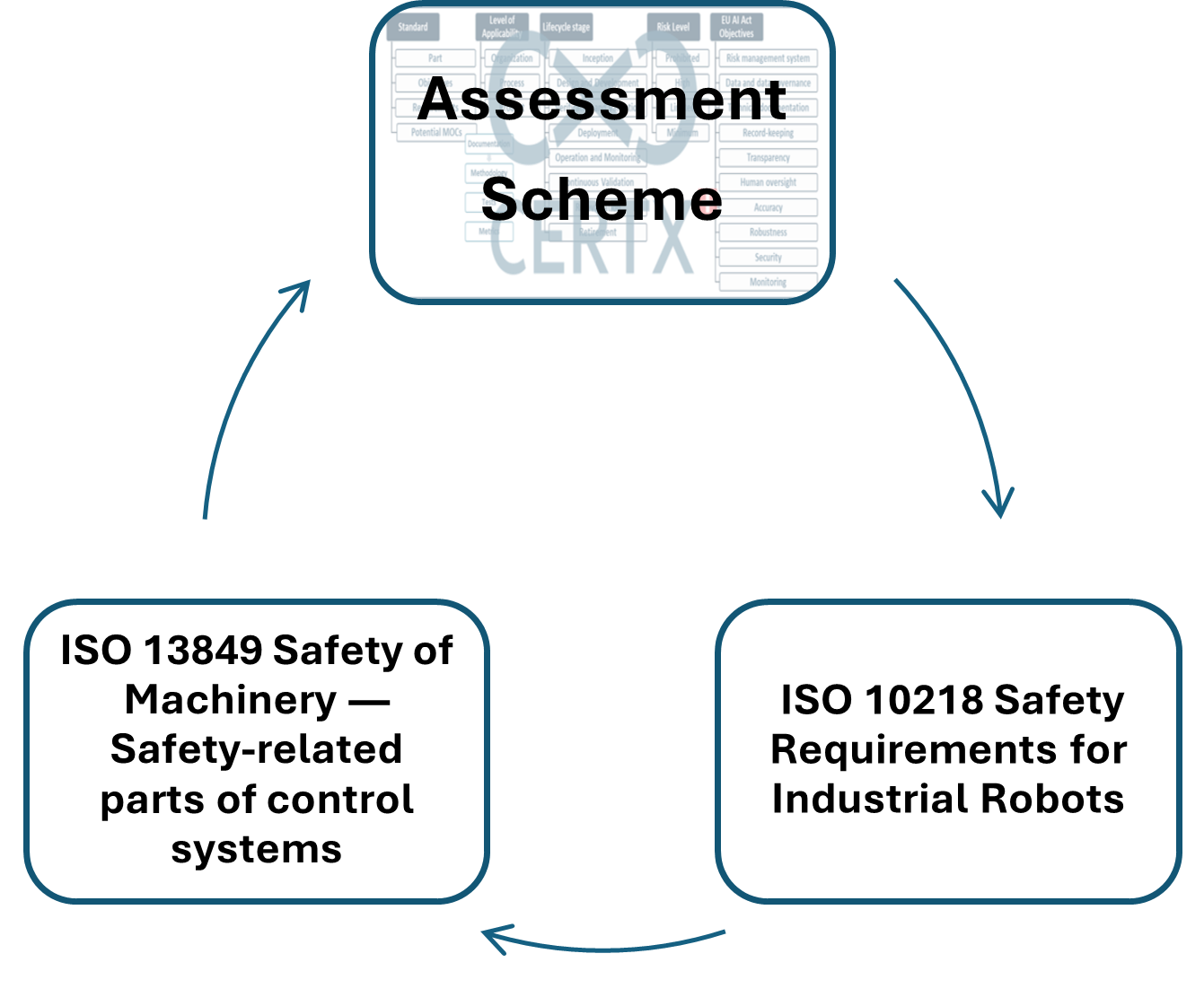
Compliance check & certification of AI components and processes against ISO/IEC TR 5469 (functional safety and AI), ISO/IEC 24029 (robustness), ISO/IEC 5259 (data quality) and ISO/IEC 42001 (AI management system), with the CertX AI assessment and certification scheme.
Supporting services to keep AI under the control of the safety architecture and to prepare for the EU AI Act and the coming AI requirements for machinery.
Training & Person Certification
CertX offers a person certification programme at several levels of expertise for those responsible for safety under IEC 61508 and ISO 13849.
- Course programmes:
- IEC 61508 Functional Safety – Red Belt
- ISO 13849 Functional Safety – Red Belt
- ISA/IEC 62443 Cybersecurity – Red Belt
- CertX experts also provide customised in-house training, for example on the Machinery Regulation and CE marking.
- Current overview of courses, venues and dates.
- More details on our training & person certification process.

See more details about our assessment process or our certification process.
Frequently asked questions
Does my safety component need a notified body?
Under the Machinery Directive, protective devices designed to detect the presence of persons and logic units ensuring safety functions are listed in Annex IV. If the product fully applies harmonised standards covering all relevant requirements, you can choose internal production control, EC type-examination or full quality assurance. If not, EC type-examination or full quality assurance by a notified body is mandatory. The Machinery Regulation keeps this logic for both categories (Annex I, Part B).
What changes with the Machinery Regulation (EU) 2023/1230?
It applies from 20 January 2027 and replaces the Machinery Directive. It adds requirements on safety-related control systems and software, protection against corruption, autonomous mobile machinery and human–machine interaction, allows digital instructions, and always requires a notified body for safety components and embedded systems with self-evolving machine learning behaviour ensuring safety functions (Annex I, Part A).
How does an EC type-examination work?
You submit the technical file and, where needed, a representative sample. We examine the design and the safety functions against the essential health and safety requirements and the applicable standards, carry out or witness the necessary tests and issue an EC type-examination certificate. Under the Machinery Directive, the manufacturer asks the notified body to review its validity every five years.
Does the Cyber Resilience Act apply to machines?
Yes, when the machine or component is a product with digital elements, for example with network interfaces, apps or remote access. Vulnerability and incident reporting applies from 11 September 2026 and all requirements from 11 December 2027. IEC 62443-4-1 and 62443-4-2 help demonstrate secure development and product security.
CONTACT US
Contact us for more information about our services for industrial machinery and safety components.